What '100% Pure Cashmere' Labels Don't Tell You: The Hidden Factors of True Luxury Quality
For luxury outerwear, the most revealing label may be the one that says the least. A coat can truthfully carry a “100% Cashmere” fiber-content statement and still differ substantially from another coat with the same wording. That is not necessarily a contradiction. U.S. labeling rules establish a baseline, not a complete definition of luxury quality. The legal framework is principally concerned with what the fiber is and whether the stated content is accurate; textile quality is a much broader physical and manufacturing question.
What “100% Pure Cashmere” Actually Tells You
A fiber-content label answers one question, not every quality question. Under U.S. Federal Trade Commission guidance, cashmere is defined for labeling purposes as fine, dehaired undercoat fiber from the Cashmere goat, with an average diameter not exceeding 19 microns and limits on the proportion of very coarse cashmere fibers. The label also has to accurately disclose fiber content. Those requirements are important because they distinguish legitimate cashmere from an arbitrary marketing claim.
But a legal threshold should not be mistaken for a luxury-grade score. Two lots can both satisfy the definition while differing in average fineness, diameter distribution, usable fiber length, curvature, cleanliness, mechanical properties, and processing history. A label saying “100% cashmere” therefore tells you about composition, not a complete hierarchy of performance.
This distinction is especially important for outerwear. A coat fabric must do more than feel soft when touched. It must form a stable cloth, tolerate handling and movement, maintain a coherent surface, and interact properly with linings, interlinings, seams, closures, pressing, and finishing. The fiber is the raw material; the garment is the engineered result.
1. Fiber Diameter Is Crucial, but “Thinner” Is Not the Whole Story
Fiber diameter is one of the most important measurable characteristics in cashmere because very coarse fibers are more likely to contribute to a harsher hand. It is also central to the legal definition used for U.S. labeling. Yet average diameter compresses a distribution of individual fibers into one number.
That distribution matters. Imagine two cashmere lots with similar average diameter. If one has a relatively tight distribution and the other contains a wider spread of finer and coarser fibers, they can behave differently. Averages can conceal variation. The FTC itself notes that trained testing can distinguish cashmere from other fibers using microscopic characteristics as well as diameter, reinforcing the point that fiber identity and quality cannot always be reduced to a single numerical claim.
There is also a practical trade-off. Extremely fine fibers can produce exceptional softness, but fine animal fibers are not automatically synonymous with maximum durability in every construction. Yarn formation, fiber length, twist, fabric density, and finishing influence how that fineness performs in the finished cloth. Recent research on fine cashmere spinning likewise emphasizes that intrinsic fiber variability and preparation quality affect yarn stability.
Decision logic: if a specification gives only an average micron figure, treat it as one data point. If detailed quality information is available, consider diameter alongside diameter variation, usable length, and processing characteristics rather than treating the smallest number as an automatic definition of superior fabric.
2. Fiber Length Helps Determine How the Raw Material Becomes Yarn
Length is one of the less glamorous but more consequential cashmere quality factors. Spinning depends on fibers having enough effective length and cohesion to form a stable yarn. A fiber assembly containing many short fibers can behave differently from one with a stronger population of longer usable fibers, even when both originate from cashmere that meets the same composition standard.
Research on cashmere processing has found relationships between raw-cashmere length and dehairing outcomes. Longer raw cashmere was associated with more efficient processing and longer resulting dehaired cashmere under the conditions studied. This is one reason raw-fiber assessment cannot stop at softness or average diameter.
Length also interacts with the intended yarn system. A fabric designed for a fine, lightweight knit does not have exactly the same structural requirements as a dense woven coating. In a luxury coat, the objective is not simply to maximize one fiber attribute; it is to build a stable textile whose hand and visual character suit the garment architecture.
3. Crimp and Curvature Influence Handle, Compression, and Processing
Cashmere does not have one universal fiber geometry. Individual fibers can exhibit different forms of crimp and curvature, and research has connected fiber curvature with crimp frequency, compression behavior, softness, and processing characteristics.
This matters because the sensation commonly described as “luxuriously soft” is partly mechanical. A textile does not feel soft simply because its fibers are chemically identified as cashmere. The way fibers bend, recover, compress, and interact with neighboring fibers contributes to the tactile response.
Objective research on rare animal fibers has found that resistance to compression is related to both fiber diameter and curvature, with curvature explaining a substantial amount of variation in measured softness. That helps explain why two cashmere fabrics with comparable fineness can still feel different.
Crimp also illustrates why visual inspection has limits. A straight-looking fiber is not necessarily poor, and a visibly lofty fabric is not necessarily superior. Fiber geometry is a property to interpret in relation to the intended yarn and cloth structure, not a decorative badge of quality.
4. Dehairing Is a Quality-Control Process, Not a Footnote
Raw cashmere contains the fine undercoat fibers valued for textile use alongside coarser guard hairs and other material. Dehairing separates useful down from unwanted coarse fibers. That process is central to the quality of the material entering spinning.
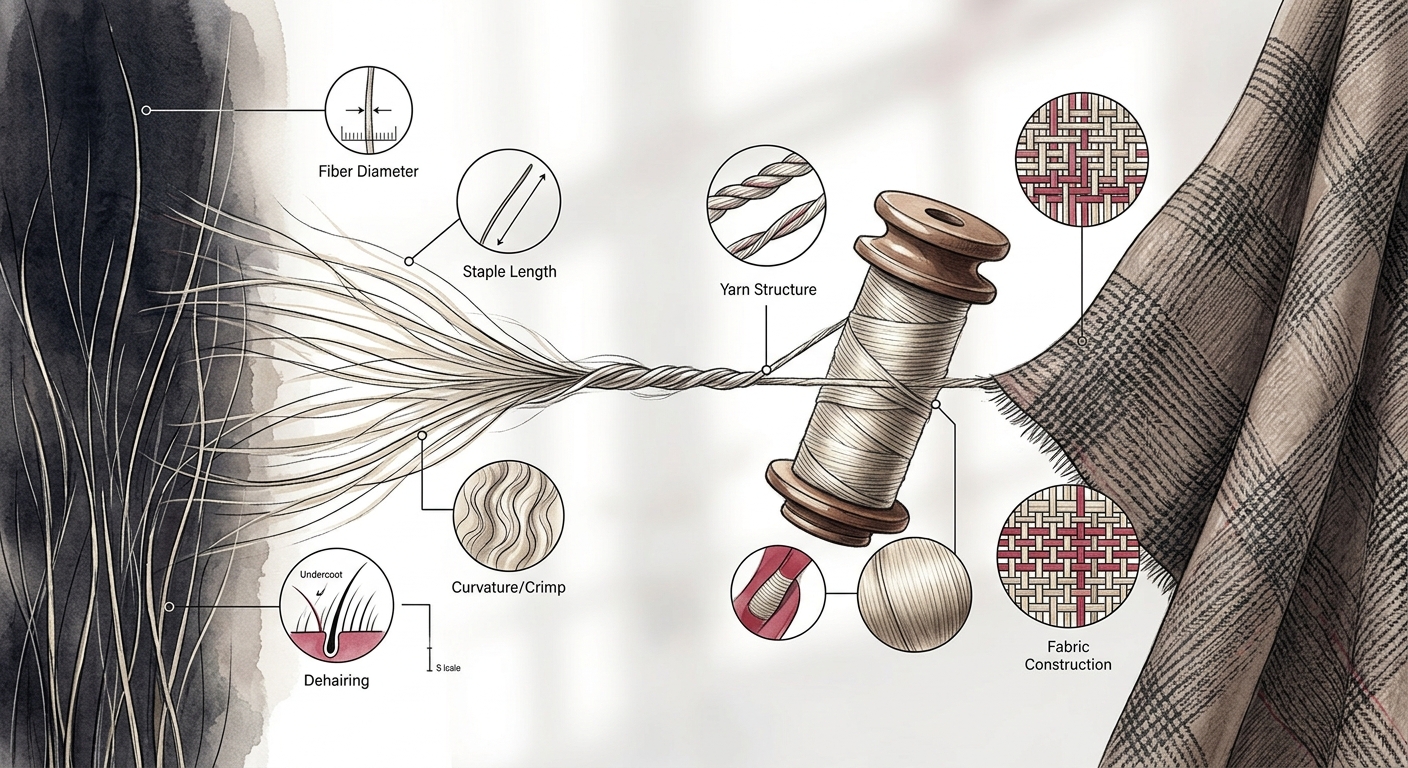
Dehairing is not a cosmetic afterthought. Peer-reviewed research has shown that raw-cashmere attributes such as length, curvature, vegetable matter, guard-hair characteristics, and visible cotting can affect processing efficiency and the resulting dehaired fiber length.
There is an important counterexample to the idea that more processing must mean better processing. Experimental work on Iranian cashmere found that additional mechanical dehairing reduced coarse-hair content but could also increase fiber breakage and shorten the remaining fibers. In other words, removing unwanted material has to be balanced against preserving useful material.
Aggressive or repeated processing can improve removal of coarse material while also causing fiber breakage. The meaningful question is not how many processing steps occurred, but whether the process produced a clean, appropriately fine, sufficiently long, and structurally useful fiber population.
5. Color, Cleanliness, and Raw-Material Condition Affect Processing
Color is often discussed as though white cashmere were inherently more luxurious than darker cashmere. That conclusion is too simple. Natural color can be aesthetically important because it affects dyeing options and shade development, but quality is not reducible to color.
Research into dehairing efficiency found that white raw cashmere, longer raw cashmere, greater fiber curvature, lower vegetable matter, normal guard-hair length, and the absence of visible cotting were associated with more efficient processing or longer dehaired cashmere. The practical lesson is that raw-material condition affects what can be achieved downstream.
For a finished coat, color should therefore be understood as one variable among several. A natural undyed cashmere fabric and a deeply dyed cashmere fabric can have different aesthetic and processing requirements without one being universally superior. The correct interpretation depends on the cloth's intended role.
6. Yarn Structure Is Where Fiber Quality Starts Becoming Fabric Quality
Even excellent fibers have to become yarn. Spinning changes the way individual fibers interact and establishes properties such as cohesion, density, twist, and surface character. Fine cashmere is technically challenging because very fine fibers can be sensitive to fiber-length distribution, defects, and preparation quality.
Recent research on fine cashmere yarns identifies residual defects and fiber clusters as important contributors to spinning instability. It also emphasizes that optimizing spinning technology alone cannot compensate fully for intrinsic variability in the raw fiber or shortcomings in preparation.
This is a crucial hidden factor. A “100% cashmere” label cannot tell you whether the yarn was engineered for a smooth, compact surface or a deliberately lofty, brushed character. Nor does the percentage specify the yarn count, twist strategy, ply structure, or the way the yarn was stabilized before weaving or knitting.
Decision logic: if the editorial question is whether two 100% cashmere fabrics can feel different, the answer is yes because fiber identity is only the starting condition. If the fabrics use materially different yarn structures, their surface, drape, resilience, and tactile response can diverge even when the fiber-content label is identical.
7. Fabric Construction Changes the Meaning of “Soft”
The finished fabric is where all those variables meet. A woven cashmere coating and a knitted cashmere fabric can use the same basic fiber while producing dramatically different experiences. Density, weave or knit architecture, yarn arrangement, finishing, and fabric weight all change how the cloth behaves.
Research on cashmere-containing knitted fabrics has shown that cashmere blend ratio and fiber curvature can affect softness, flexibility, suppleness, and other mechanical characteristics. This demonstrates a broader principle: fabric behavior emerges from fiber plus construction.
For luxury outerwear, construction is especially significant. A coat requires dimensional stability and enough body to support a silhouette. An ultra-soft fabric that collapses excessively may be beautiful in one application and poorly suited to another. Conversely, a denser cashmere cloth can feel less immediately plush but may create a more structured outerwear profile.
That is why “softest” and “highest quality” should not be treated as interchangeable phrases. Luxury quality can involve controlled softness, resilience, drape, surface clarity, warmth, weight, and stability in combination.
8. Finishing Can Change Surface Character Without Changing Fiber Content
After weaving or knitting, finishing can influence the visual and tactile character of cloth. Raising, brushing, pressing, compacting, and other textile processes can alter surface appearance and hand. None of those processes changes a 100% cashmere fiber-content statement into a different fiber composition.
This is another reason labels cannot tell the entire story. A fabric can be made from the same raw fiber but finished toward different aesthetic goals. One may have a clean, relatively compact surface suitable for a tailored coat; another may be deliberately brushed for a softer visual halo.
Surface effects can also evolve with wear. Loose fibers, abrasion, friction, and repeated handling can change the appearance of a garment without proving that the original fiber was inferior. Surface appearance is not the same as fiber quality.
9. A Practical Quality Check: Read in Layers
A useful way to interpret cashmere is to move from the simplest question to the most technical one. First establish what the garment is made of. Then consider the physical attributes that determine fiber behavior. Finally, consider how manufacturing turns those fibers into cloth.
Practical action checklist
- Check composition: Confirm whether the stated fiber content is 100% cashmere or a disclosed blend. A fiber-content label is the foundation, not the entire assessment.
- Look for technical context: If published, note fiber diameter, diameter variation, usable fiber length, and other objective specifications rather than focusing on one micron number.
- Consider processing: Ask whether the available information distinguishes fine undercoat fiber from coarse material and whether dehairing or preparation is described with meaningful technical detail.
- Examine the cloth: Consider density, surface consistency, drape, structure, and whether the fabric's hand fits the intended outerwear silhouette.
- Interpret softness carefully: If a fabric is exceptionally soft, ask what else produces that sensation: fine fibers, curvature, yarn structure, finishing, or several factors together.
- Check care instructions: Cleaning and storage practices can preserve the properties of a good textile, although care cannot turn a poorly constructed cloth into a premium one.
- Use a testing mindset for high-stakes claims: If exact fiber composition is disputed, laboratory fiber identification is more meaningful than judging authenticity by touch alone.
10. Summary Table: What the Label Misses
11. Important Exceptions and Trade-Offs
The phrase “higher quality” needs context. An exceptionally fine fiber is not automatically the correct fiber for every textile purpose. A very lofty surface is not necessarily preferable for a sharply tailored coat. A darker natural color is not evidence of inferior fiber. A fabric that feels less buttery on first touch may possess a denser construction that suits structured outerwear better.
There is also a distinction between raw-material quality and garment quality. A superb fiber can be undermined by poor spinning, weak construction, inconsistent finishing, or inappropriate garment engineering. Conversely, skilled textile construction can make a material perform impressively without possessing every theoretically desirable raw-fiber attribute.
Who is this framework most useful for? It is useful for anyone trying to understand why two apparently equivalent cashmere garments can behave differently. It is less useful as a simplistic ranking system, because textile quality is application-dependent. The right question is not “Which cloth has the most luxury signals?” but “Which combination of properties creates the intended performance and character?”
12. Care Preserves Quality; It Does Not Manufacture It
A quality fabric still needs appropriate maintenance. Cashmere can develop surface changes through ordinary friction and wear, and cleaning methods can affect dimensional stability and surface character. The FTC requires applicable apparel care instructions and notes that care information must accurately communicate a safe cleaning method.
Cleaning method matters because processing continues after purchase. Gentle handling, appropriate cleaning, adequate drying, and sensible storage can help preserve the original characteristics of a fine animal fiber. But care can only preserve the qualities that are already present. It cannot compensate for excessively short fibers, poor yarn formation, unsuitable construction, or excessive processing damage.
This is another useful test of luxury claims: a good care program should be presented as preservation, not as a magical solution to fundamental textile weaknesses.
Frequently Asked Questions
Does 100% cashmere mean the fabric is the highest possible quality?
No. It primarily communicates fiber composition under the applicable labeling framework. Quality also depends on fiber fineness and variation, length, curvature, cleanliness, processing, yarn structure, fabric construction, finishing, and intended use.
Is a lower micron number always better?
No. Fineness is highly important, especially for tactile comfort, but it is not the only variable. Fiber-length distribution, strength, curvature, yarn engineering, fabric density, and finishing can materially change the final textile.
Why does fiber length matter in cashmere?
Usable fiber length influences how fibers cohere during spinning and can affect yarn stability and processing efficiency. Research has linked raw-cashmere length with dehairing outcomes and resulting dehaired fiber length.
What does dehairing do to cashmere?
Dehairing separates desirable fine undercoat fibers from coarser guard hairs and other material. It can improve the usable fiber population, but excessive processing can also cause fiber breakage and shorten the retained fibers.
Why can two cashmere fabrics feel different if both are 100% cashmere?
Because the label does not specify fiber geometry, yarn construction, fabric density, weave or knit structure, finishing, or other variables that determine the final hand and behavior of the cloth.
Does softness prove that cashmere is high quality?
Softness is informative but not conclusive. Objective research connects softness and compression behavior with factors including fiber diameter and curvature. A very soft fabric can still have construction or durability characteristics that make it unsuitable for a particular application.
Can you identify genuine cashmere by touch alone?
Touch can provide useful sensory information, but it is not a substitute for laboratory fiber identification when composition is disputed. The FTC notes that trained experts can use microscopic characteristics and established testing procedures to distinguish cashmere from other fibers.
Does natural white cashmere automatically indicate superior quality?
No. Color can affect dyeing and aesthetic possibilities, and some research has associated white raw cashmere with processing outcomes under particular conditions. But color alone cannot establish overall textile quality.
The Information-Synthesis Conclusion: Luxury Is a Chain, Not a Label
The phrase “100% pure cashmere” is useful precisely because it answers a limited question: what fiber is represented in the garment? The mistake is expecting that statement to answer every other question at once.
The deeper cashmere quality factors form a chain. Fine undercoat fiber must be appropriately characterized. Diameter distribution matters alongside the mean. Fiber length affects processing and spinning. Curvature and crimp influence compression and tactile response. Dehairing must remove undesirable material without unnecessarily damaging the useful fiber population. Yarn engineering turns those fibers into a coherent strand. Fabric construction determines how that yarn behaves as cloth. Finishing shapes the surface. Garment construction determines whether the resulting fabric actually performs as luxury outerwear.
That chain explains why two garments carrying the same fiber-content statement can occupy very different positions in textile performance and aesthetic character. “100%” is a composition statement. True luxury quality is the accumulated result of material selection, controlled processing, textile engineering, construction, finishing, and appropriate care.
The most revealing way to read a cashmere label, then, is not to dismiss it but to put it in perspective. Start with composition, move to measurable fiber characteristics, consider processing, then look at yarn and cloth. Once those layers are understood, the familiar “100% Cashmere” tag becomes what it should have been all along: a starting point for understanding the textile, not the final word on its quality.


Comments
Post a Comment